
More Than 1.27 Million Pupils Return to UAE Schools as New Academic Year Begins with Sweeping Changes

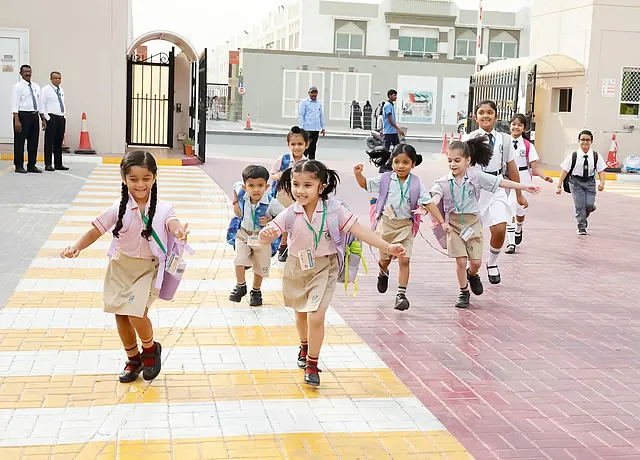
More than 1.277 million students will begin the 2026–2027 academic year on Monday, August 31, at more than 1,180 public and private schools across the UAE. The new school year will feature a phased return during the first few days, along with changes to homework, the use of digital tools, assessment methods and Arabic-language instruction.
The UAE Ministry of Education said all academic, administrative, operational and technical preparations for the new school year had been completed. Ahead of schools reopening, 11 new schools, education complexes and kindergartens have opened, 5,810 school buses have been readied and about 8 million textbooks have been distributed. A further 26,700 new students have enrolled in public schools.
Phased return over first four days
The academic year officially begins on Monday, August 31, but students will return in phases over the first four days. Under the framework announced by the Ministry of Education, participating schools may bring different grades back on separate days and for shorter school hours from Monday, August 31, to Thursday, September 3. Each school will set its attendance schedule based on its readiness and circumstances.
During this period, only students scheduled for a particular day will attend school, while other grades will remain at home. The phased return will end on Friday, September 4, after which all students will attend school according to the regular timetable. The ministry said the initiative aims to ensure an orderly and safe return while gradually preparing schools for full attendance.
Homework scrapped for younger pupils
One of the most significant changes this academic year is the removal of traditional homework for public school pupils from kindergarten through Grade 2.
Instead of daily homework, families will be encouraged to support children in reading at home every day. The Ministry of Education said the decision was intended to create a better balance between school and family life, strengthen language and cognitive skills, and make reading a habit from the earliest years of education.
Tighter limits on screen use
Another change concerns the use of digital tools in public schools. The “Regulating the Use of Digital Tools in Education” initiative will be expanded this year to include all Grade 6 pupils in public schools.
The decision followed a study involving 2,500 pupils at nine public schools. Preliminary findings showed that pupils in classes where the use of digital tools was restricted achieved better academic results, particularly in mathematics, science and Arabic. Their concentration and classroom behaviour also improved.
Sarah Al Amiri, the UAE Minister of Education, said Grade 6 subjects including Arabic, English, science and mathematics would place greater emphasis on books, paper and notebooks, without continuous reliance on screens. She said the aim was not to abandon technology, but to strike a balance between its use and the development of pupils’ fundamental skills.
Changes to Grading for Secondary School Students
The Ministry of Education has also revised the assessment weighting for Cycle 3 students. In core subjects, 50 per cent of the final grade will now be based on school assessments and 50 per cent on central examinations.
Diagnostic assessments will also be conducted in schools, enabling teachers to identify students’ academic levels and learning gaps at the start of the year and adjust teaching plans and educational support accordingly.
Greater Focus on Arabic
The second phase of Arabic language proficiency assessments will also be expanded this year. The initiative will cover all 19,000 Grade 1 students at 162 public schools and 11,000 Grade 1 students at 130 private schools.
The programme was piloted in 100 schools last year. It aims to identify children’s Arabic language proficiency at an early stage and provide educational support from their first years of schooling.
Expansion of Project-Based Learning
The project-based learning and assessment programme has also been expanded to more than 129,000 students across 366 schools. In one of its key components, Grade 7 students will, for the first time, complete a joint project integrating four subjects: Arabic, English, mathematics and science.
The Ministry of Education says the approach aims to connect theoretical knowledge with practical application and strengthen skills such as problem-solving, critical thinking and the ability to make connections across different subjects.
All Schools to Be Evaluated Within Two Years
A project to evaluate all public schools and private schools licensed by the Ministry of Education will also begin in the first term of this academic year. The process will take place over two academic years and assess schools’ educational and organisational performance against national standards.
More than 24,000 teachers, school leaders and education specialists have participated in over 80 training programmes and workshops, while a separate programme has been delivered for more than 1,700 school principals. Some of the training focuses on the use of artificial intelligence and emerging technologies in education.
Changes to Entry Ages for Kindergarten and Grade 1
The 2026–2027 academic year will also mark the first implementation of new age requirements for school admissions. For schools where the academic year begins in August or September, the age cut-off date has been moved from August 31 to December 31.
Under the new rules, children must have turned three by December 31 to enter pre-kindergarten, four to enter KG1, five to enter KG2 and six to enter Grade 1. The change applies only to new admissions and will not affect students who are already enrolled.
According to the Ministry of Education’s official calendar, the 2026–2027 academic year will begin on August 31 and include 185 instructional days. The final day of the academic year for students will be July 2, 2027.