
5 Ancient Sea Turtle Carvings Discovered in Sharjah Mountains, Possibly 7,000 Years Old
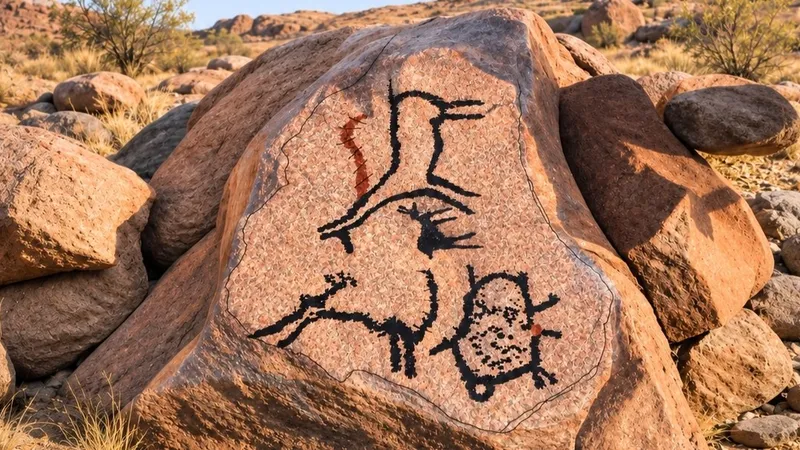
The Sharjah Archaeology Authority has announced the discovery of five rare rock carvings depicting sea turtles in the mountains of Wadi Al Helo, estimated to be around 7,000 years old. Found in a mountainous area far from the sea, the carvings could offer new insights into links between mountain and coastal communities in prehistoric times, researchers said.
The carvings were identified during field surveys conducted this year by the Sharjah Archaeology Authority on a newly documented rock-art surface.
Local residents first drew archaeologists’ attention to the area in 2022, but the five new carvings were discovered during surveys carried out in 2026.
Researchers believe the carvings may date to around 5000 BC, although their exact age has yet to be conclusively established.
Leatherback turtle carvings identified in Sharjah mountains
One of the most significant aspects of the discovery is that four of the five carvings resemble the leatherback sea turtle, the world’s largest living sea turtle species.
Archaeologists said the creators carved distinct lengthwise lines along the turtles’ backs, closely resembling the natural ridges found on the species’ shell.
These details have helped researchers identify the likely species of the animals depicted.
Experts said the inclusion of such features suggests that the carvings’ creators were probably familiar with the animals’ appearance.
However, it remains unclear whether the region’s ancient inhabitants had seen sea turtles firsthand or learned about them through contact with other communities.
Why do images of marine animals in a mountainous region matter?
One of the key questions for archaeologists concerns the geographical location of the carvings.
Wadi Al Helo lies in a mountainous part of the emirate of Sharjah, and the newly discovered carvings were found a considerable distance from the sea.
The presence of sea turtle images in such a location raises questions about how ancient inland communities became familiar with these animals.
Researchers are examining the possibility that mountain and coastal communities were connected through travel, exchanges of information or trade networks.
Such links could have brought knowledge of marine animals to areas far from the coast.
However, the carvings alone are not sufficient to prove the existence of specific trade routes or direct contact between communities, and further archaeological research is needed.
Third known site with this type of carving on the Oman Peninsula
According to the Sharjah Archaeology Authority, the subject matter of the carvings also makes the discovery exceptionally rare.
Before the Wadi Al Helo carvings were identified, only two other sites featuring similar depictions of this type of sea turtle were known on the Oman Peninsula.
Wadi Al Helo is therefore the third known site in the region where such carvings have been documented.
Researchers have also suggested that sea turtles may have held symbolic significance for the carvings’ creators or may have been associated with practices such as traditional healing, in addition to reflecting familiarity with the natural environment.
However, these theories remain unconfirmed, and the reason sea turtles were chosen as the subject of the carvings is still unknown.
The creators may have seen the animals firsthand, heard stories about them or attached particular cultural and symbolic meaning to them.
Why the discovery matters for understanding Sharjah’s ancient history
Wadi Al Helo is one of Sharjah’s most important archaeological areas, where evidence of settlement and human activity from various historical periods has previously been found.
The area is particularly significant to archaeological studies of the southeastern Arabian Peninsula because of evidence of copper mining and smelting during the Bronze Age.
The newly discovered carvings could help researchers better understand possible links between mountain and coastal communities and examine Wadi Al Helo’s role in prehistoric communication networks.
The Sharjah Archaeology Authority said the discovery reveals another aspect of the emirate’s cultural heritage and highlights the importance of continuing to document and protect rock art.
Archaeologists are continuing to investigate the carvings’ exact age, meaning and historical context to determine the role sea turtles may have played in the lives and beliefs of communities that inhabited the area thousands of years ago.