
Abu Dhabi Uses Smart Drones to Disperse 10 Million Mangrove Seeds, Cutting Restoration Costs
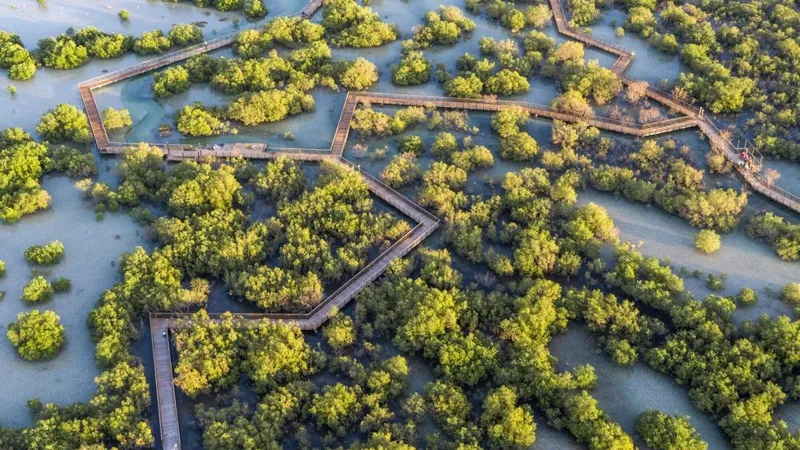
Abu Dhabi-based environmental technology company Nabat, in partnership with the Environment Agency – Abu Dhabi, has used artificial intelligence and autonomous drones to disperse 10 million mangrove seeds in 2026. The company said the new technologies could reduce mangrove restoration costs to between one-third and one-fifth of those associated with traditional methods.
According to Arabian Business, Nabat is working with the Environment Agency – Abu Dhabi (EAD) to deploy drones equipped with high-resolution cameras and AI systems to identify suitable seeding areas, assess vegetation cover and monitor the results of environmental restoration projects.
The company said a single operations team can use drone imagery to survey about 800 hectares a day, equivalent to more than 1,100 football pitches. Autonomous drones can also disperse mangrove seeds across 50 to 60 hectares daily, equivalent to about 70 to 84 football pitches.
Mehdi Ajana, vice president of strategy at Nabat, told Arabian Business that the technology helps address longstanding environmental restoration challenges, particularly identifying suitable planting areas and assessing the success of restoration projects.
“We have advanced systems to manage cities, infrastructure and businesses, but very limited tools to understand and manage nature,” he said.
Highlighting the importance of mangrove forests, Ajana added: “We know these forests protect coastlines, support biodiversity and store carbon. However, fundamental questions remain difficult to answer: Where exactly are mangroves located? How healthy are they? Where should we intervene? And are restoration efforts actually working?”
Nabat began using drone imagery, satellite data and AI models to assess environmental conditions three years ago, in partnership with the Environment Agency – Abu Dhabi.
According to Ajana, traditional field surveys typically rely on sampling limited sections of an area and extrapolating the findings across the entire site, while AI allows for more detailed assessment of all areas undergoing restoration.
“With drones and AI, one team can survey about 800 hectares a day using high-resolution imagery. At the highest resolution, down to the millimetre scale, our AI can identify very small mangrove seedlings across the entire area, rather than only at locations visited by field teams,” he said.
10 Million Mangrove Seeds to Be Sown in 2026
Nabat announced that it dispersed 10 million mangrove seeds in 2026 in collaboration with the Environment Agency – Abu Dhabi. The initiative supports the UAE’s broader goal of planting 100 million mangrove trees by 2030.
However, the company’s vice president of strategy stressed that the number of seeds dispersed should not be equated with the number of trees successfully established.
Ajana said: “This year, in collaboration with the Environment Agency – Abu Dhabi, we dispersed 10 million mangrove seeds. This is a significant operational achievement, but it does not mean we have established 10 million trees. What matters is what happens after the seeds are dispersed.”
According to Ajana, mangrove restoration projects in the UAE have recorded successful plant establishment rates of around 40 to 50 per cent when target areas are selected using scientific criteria such as soil conditions, land elevation and tidal exposure.
To assess the progress of restoration projects, Nabat monitors indicators including seed establishment, seedling survival, vegetation cover, plant density and biomass.
The company has also developed an artificial intelligence-based model to assess the suitability of mangrove restoration sites along the coastlines of Gulf Cooperation Council member states.
The model helps environmental project operators identify areas where mangrove planting is more likely to succeed.
Ajana also explained that the technology can identify areas where natural vegetation regeneration has already begun and where additional seed planting may not be necessary.
“Our analysis also identifies areas where natural regeneration is under way,” Ajana said. “In such locations, the best approach may be to reduce environmental pressures and allow nature to recover on its own. Planting is not always necessary.”
Does Using Artificial Intelligence Really Help the Environment?
Despite the technology’s operational benefits, Ajana stressed that its environmental impact must also be considered when assessing the benefits of using AI in ecosystem restoration projects.
“Using AI for an environmental purpose does not necessarily mean the technology is beneficial to the environment,” he said.
“The first question is whether the technology improves our decision-making and outcomes,” he added. “We examine the resources required to carry out activities and their resulting environmental impact. Where possible, we also compare restored areas with control sites to determine what changes have resulted from our interventions.”
When assessing its technology’s environmental footprint, Nabat considers the resources used for computing, image acquisition and field operations. However, the company has yet to complete a comprehensive quantitative assessment of the technology’s net environmental impact.
Ajana stressed that the true success of ecosystem restoration projects should be measured by long-term ecological outcomes, rather than simply by the number of seeds dispersed or trees planted.
“Restoring an ecosystem takes years,” he concluded. “The initial establishment of plants is promising, but it is not the same as developing a mature, functioning ecosystem. Rather than announcing how many trees we have planted, I would prefer to report how many have survived and are thriving.”