
UAE Explores Drones to Boost Rainfall, Allocates $3 Million for New Research
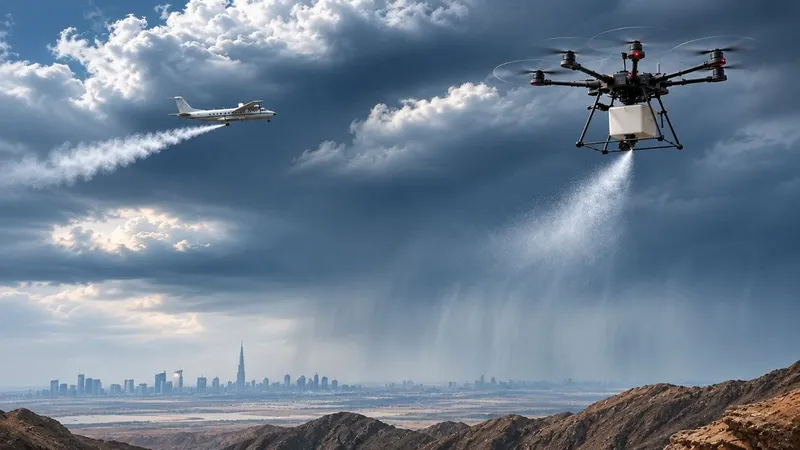
The UAE is exploring new ways to increase rainfall using autonomous drones, advanced cloud-seeding materials and artificial intelligence. As part of these efforts, the seventh cycle of the UAE Research Program for Rain Enhancement Science has been launched with a total budget of $3 million to support up to five research projects.
The program, managed by the UAE National Center of Meteorology (NCM), focuses on developing technologies that go beyond conventional cloud-seeding methods.
The official call for proposals was issued on November 5, with applications for research projects set to open on December 8, 2026. Selected projects will run for between one and three years, depending on their subject and scope.
The program builds on the results of 17 research projects supported during the previous six cycles and covers five main research areas.
Exploring the use of autonomous drones for cloud seeding
One of the main priorities of the UAE’s latest research cycle is to explore the use of drones and unmanned aerial systems in rain enhancement operations.
Researchers have been invited to submit proposals for drones capable of identifying clouds suitable for seeding, collecting atmospheric data and delivering seeding materials to targeted locations with greater precision.
The coordinated deployment of multiple drones in a single operation is another area of interest under the program.
Under the UAE’s conventional cloud-seeding method, specialised aircraft release moisture-attracting particles, typically salt compounds, into suitable clouds.
These particles can help small water droplets collide and merge, increasing the likelihood of larger droplets forming and rain falling under favourable conditions.
However, the success of these operations depends on factors including humidity levels, cloud temperature, atmospheric updrafts and natural weather conditions.
The new drone technologies outlined in the seventh cycle are still at the research proposal stage, and their inclusion does not mean that large-scale cloud-seeding operations using these systems have begun.
Developing new materials and exploring innovative cloud-formation methods
Another focus of the program is the development of advanced cloud-seeding materials and an assessment of their performance in hot, arid environments.
Researchers may examine the physical and chemical properties of particles, how they disperse through the atmosphere and the potential effect of new compounds on increasing rainfall.
The potential environmental impact of the proposed materials will also be studied.
Another part of the program is dedicated to methods that go beyond conventional cloud seeding, including research into whether cloud formation can be influenced when atmospheric conditions are close to the required threshold.
Other priorities include studying how land cover, terrain, atmospheric moisture and localised heating affect weather conditions in limited areas.
However, this research does not mean that technology can produce rain at any time or in any location.
The World Meteorological Organization has stressed that, because of the immense energy involved in weather systems, known technologies cannot create rain-producing cloud systems on demand, and claims of such capabilities should be treated with caution.
How artificial intelligence could improve cloud-seeding accuracy
Artificial intelligence, advanced computer models and meteorological data analysis are also among the main priorities of the seventh cycle of the UAE Research Program for Rain Enhancement Science.
The research aims to improve weather forecasting, identify clouds suitable for seeding and provide more accurate assessments of operational results.
In previous cycles, the UAE also supported research into using artificial intelligence to identify suitable clouds and developing radar technologies to examine their internal structure.
One of the main challenges in this field is determining how much additional rainfall is generated by cloud-seeding operations.
Rainfall following an operation does not necessarily prove that human intervention caused it, as the cloud may also have produced rain naturally.
According to the World Meteorological Organization, scientifically evaluating these operations requires controlled trials, comparisons between seeded and unseeded conditions, physical measurements and statistical analysis.
The organisation has also said that scientific evidence of increased precipitation is stronger for some cold mountainous clouds, while determining the impact of seeding on complex convective clouds remains difficult.
$3 million budget for up to five projects
According to the program’s official announcement, a total of $3 million has been allocated in the seventh cycle to support up to five research projects.
Funding will be determined according to project duration across three categories:
- One-year projects: up to $500,000
- Two-year projects: up to $1 million
- Three-year projects: up to $1.5 million
These figures represent the maximum funding available in each category and do not mean that applicants will automatically receive the full amount.
Research proposals will undergo a two-stage evaluation based on scientific merit, innovation, methodology, the research team’s capabilities and the suitability of the proposed budget.
Dr Ahmed Al Kamali, director of the UAE Research Program for Rain Enhancement Science and acting head of cloud-seeding operations at the National Center of Meteorology, said the new cycle builds on the scientific and technological achievements of previous rounds.
He said the aim is to support research that addresses important scientific questions, presents innovative approaches and offers a clear path towards the practical application of new technologies.
Application timeline and announcement of selected projects
According to the official timetable for the seventh cycle, the application portal will open on December 8, 2026.
Researchers and institutions must complete their initial registration by March 5, 2027, and submit preliminary research proposals by March 12, 2027.
Following the initial review, shortlisted applicants will be invited by May 31, 2027, to submit full proposals.
The deadline for invited applicants to submit full proposals is August 28, 2027.
Final funding decisions are expected to be announced in January 2028, with selected projects scheduled to begin in March 2028.
Successful projects will run for between one and three years, depending on their duration and research objectives.
Can new technologies increase rainfall in the UAE?
The UAE has invested in rain enhancement technologies for years because of its arid climate and limited natural freshwater resources.
However, the effectiveness of new methods must be established through scientific trials and data analysis.
Experts say key questions include how much additional rainfall new technologies can generate, where that rainfall will occur and how consistently the results can be replicated.
By focusing on autonomous drones, new cloud-seeding materials, potential methods of influencing cloud formation and artificial intelligence, the seventh cycle of the UAE research program aims to develop technologies that could improve the accuracy and efficiency of rain enhancement operations in the future.