
UAE Again Condemns ‘Iranian Drone Attack’ on Kuwait, Reaffirms Full Support
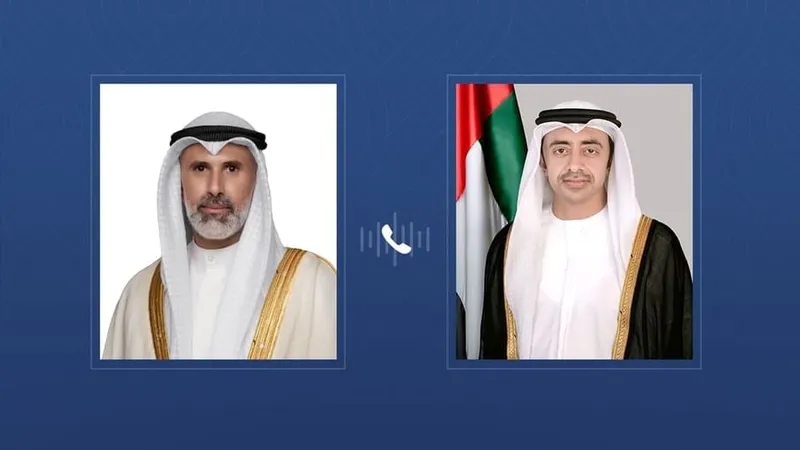
Sheikh Abdullah bin Zayed Al Nahyan, UAE Deputy Prime Minister and Minister of Foreign Affairs, held a phone call on Saturday, November 28, 2026, with Sheikh Jarrah Jaber Al-Ahmad Al-Sabah, Kuwait’s Minister of Foreign Affairs. During the call, he strongly condemned the November 26 drone strike on Kuwait, which killed two Italian technicians, describing it as an “Iranian act of aggression”. The UAE foreign minister also reaffirmed his country’s full solidarity with Kuwait and its support for all measures taken to safeguard the country’s security and stability. He offered condolences to the victims’ families and wished the injured a speedy recovery.
The two ministers also discussed regional developments. In a statement on the call, Kuwait’s Ministry of Foreign Affairs said both sides had affirmed Kuwait’s full right to take all necessary measures to protect its sovereignty, security and stability. They also called for continued coordination and consultations on ongoing developments.
Kuwait’s Ministry of Defence said on Thursday that the country’s armed forces had intercepted several “hostile” drones in Kuwaiti airspace. According to the ministry, the “Iranian aggression” targeted one of Kuwait’s vital facilities, with falling debris injuring four people and causing material damage. The ministry did not identify the facility. It later announced that two Italian nationals had died from their injuries. The other two injured people were a Kuwaiti citizen and a Pakistani national.
Italian Foreign Minister Antonio Tajani told the country’s Senate that the two victims were technicians employed by Rheinmetall Italia, the Italian subsidiary of German defence group Rheinmetall. He said they were killed when Iranian drones targeted the air-defence detection station where they worked at around 2pm local time, causing a powerful explosion, according to information received from Kuwait. Italy’s Ministry of Foreign Affairs said the technicians were in Kuwait to maintain detection antennas for an air-defence system operated by the Kuwaiti Armed Forces. The Kuwait Times identified them as Antonio Saccoccio and Emanuele Lo Russo.
Kuwait summoned Iranian Ambassador Mohammad Totonchi on Friday, November 27. Kuwaiti Deputy Foreign Minister Hamad Sulaiman Al-Mashaan handed him a formal protest note. The note described the continued Iranian attacks as a flagrant violation of Kuwait’s sovereignty and territorial integrity and a serious breach of international law, holding Iran fully responsible for the attacks and their consequences. It stressed that Kuwait reserved its inherent right to self-defence under Article 51 of the United Nations Charter.
Iran, meanwhile, denied any involvement in the attack. Brigadier General Abolfazl Shekarchi, senior spokesperson for Iran’s Armed Forces, said Iran had conducted no military operations or attacks in the region. He accused the United States and Israel of staging a false-flag attack to destabilise the region. Iranian Foreign Minister Abbas Araghchi had previously rejected the allegation in a phone call with his Kuwaiti counterpart. He described the incident as suspicious and proposed a joint investigation by Iran, Kuwait and Italy to determine the origin of the attack.
The UAE Ministry of Foreign Affairs had earlier issued a separate statement describing the attack as a violation of Kuwait’s sovereignty and a threat to its security. Saudi Arabia also held Iran responsible for the consequences of the continued attacks, while Qatar described the incident as a flagrant violation of Kuwait’s sovereignty. UN Secretary-General António Guterres condemned the attack, expressed solidarity with Kuwait and urged all sides to exercise restraint, stressing that dialogue and diplomacy were the only path to lasting peace.
Since the outbreak of the US-Israeli war with Iran on February 28, 2026, Kuwait and other Arab countries in the region have repeatedly been targeted by drone and missile attacks. Tehran says the strikes target bases and facilities linked to the United States. Kuwait hosts US forces at several bases, including Ali Al Salem Air Base and Camp Arifjan. Following a November 18 drone attack on Kuwait, the Iranian military said it had targeted US Patriot air-defence systems and drone and missile launch platforms at Ali Al Salem Air Base.