
TankerTrackers: Oil exports from seven Middle Eastern countries near pre-war levels; Iran’s share at zero
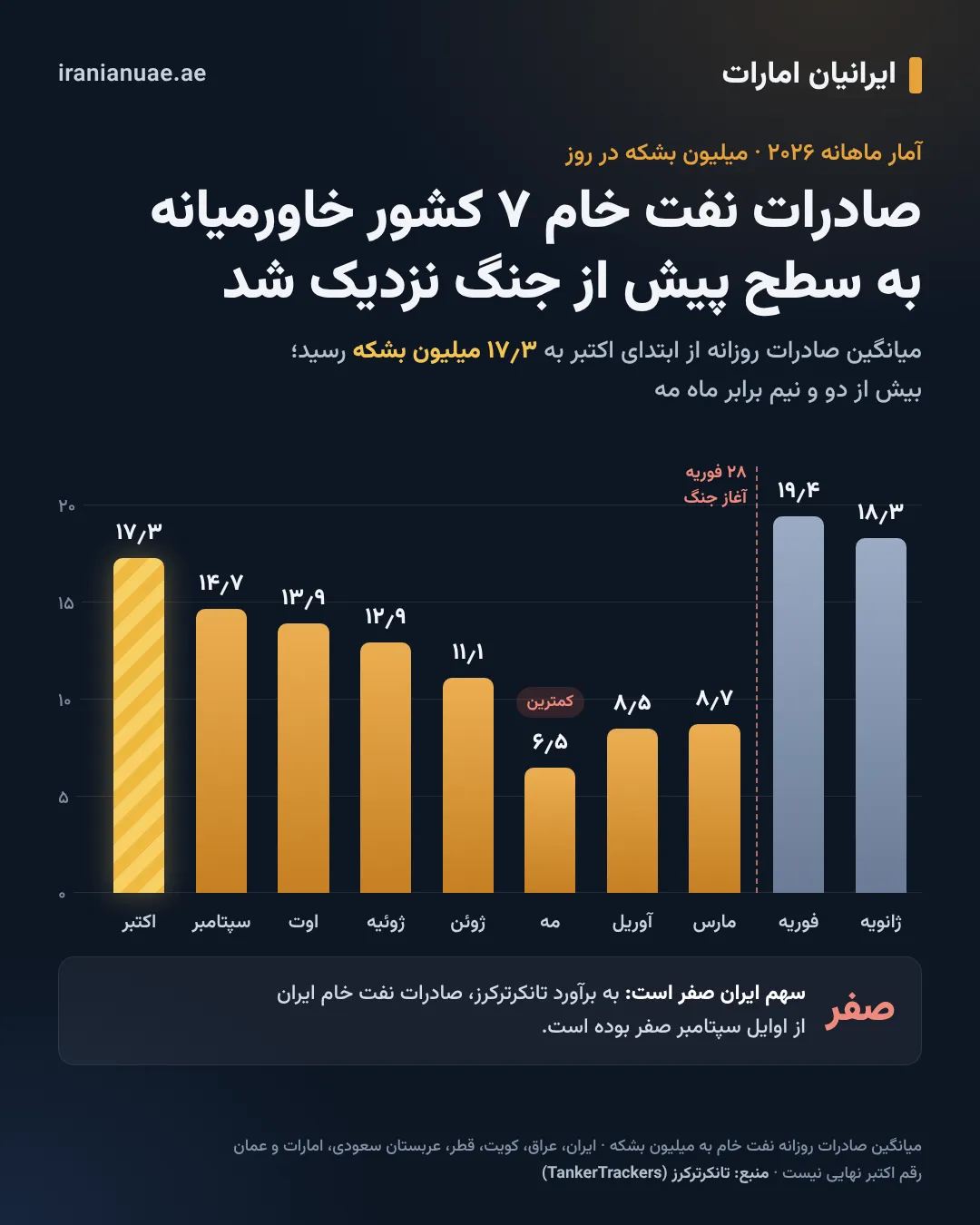
Crude oil exports from seven countries in the region have averaged 17.3 million barrels per day since the start of October, according to oil tanker tracking firm TankerTrackers. That is more than two and a half times the May level, narrowing the gap with the pre-war January-February average to about 1.6 million barrels per day. The firm continues to estimate Iran’s crude exports at zero. The recovery has coincided with a new wave of attacks on tankers in the Strait of Hormuz.
According to data published by TankerTrackers on X, combined crude exports from Iran, Iraq, Kuwait, Qatar, Saudi Arabia, the UAE and Oman stood at 18.3 million and 19.4 million barrels per day in January and February 2026, respectively. Following the US and Israeli attack on Iran on February 28 and the effective closure of the Strait of Hormuz, exports fell to 8.7 million barrels per day in March and reached a low of 6.5 million in May. They rose to 11.1 million barrels per day in June after Washington and Tehran signed a memorandum of understanding that later collapsed, and continued to increase month on month, reaching 14.7 million in September. The October figure, which is not yet final, is about 18 per cent higher than September’s.
TankerTrackers said Iran exported 1.68 million barrels of crude oil per day before the war. In a report in early September, the firm put Iran’s exports at zero and said the situation could continue “for the foreseeable future”, depending on the outcome of any potential agreement. TankerTrackers repeated the same figure in a September 30 post on X. Iranian ports are under a US naval blockade. Ship-tracking company Kpler reported that the country’s crude oil production had fallen to about 1.8 million barrels per day, roughly equal to domestic demand and close to half its pre-war output.
Kpler estimated in early October that about 40 per cent of the region’s oil exports were bypassing the Strait of Hormuz. Reuters reported on Thursday, October 8, citing analysts, that exports from the Gulf of Oman and Red Sea coasts had risen to 6.7 million barrels per day, more than double pre-war levels. Saudi Arabia sends some of its oil through the East-West pipeline to the Red Sea port of Yanbu. The UAE also uses the Habshan-Fujairah pipeline, which can transport up to 1.8 million barrels per day, to export oil through Fujairah port on the Gulf of Oman coast. CNBC reported that the recovery in exports in September was largely driven by US military escorts for tankers along a route close to Oman’s coast.
However, weekly data from Kpler points to a decline in oil flows in the first week of October. Regional crude exports had exceeded the pre-war average on four days during the final week of September. According to CNBC, citing Kpler data, exports fell to 15.3 million barrels per day in the week ending October 7, 10 per cent below pre-war levels. Oil flows through the Strait of Hormuz stood at 8.5 million barrels per day that week, about 40 per cent lower than before the war.
Attacks on vessels in the Strait of Hormuz intensified in October. CNBC reported that 11 oil tankers were attacked while transiting the strait in the week ending October 4, the highest number since the war began. The UK Maritime Trade Operations agency recorded 18 attacks on vessels in and around the Strait of Hormuz during the first 12 days of October. Six of those attacks occurred on Sunday, October 11, alone. On Tuesday, October 13, the agency also reported that a container ship and an oil tanker had been struck by unidentified projectiles north of the Musandam Peninsula.
The Islamic Revolutionary Guard Corps claimed responsibility for an attack on an oil tanker on Monday, October 12, saying it was the third vessel targeted in two days. Iran also claimed to have struck an ADNOC-owned supertanker. ADNOC Logistics, the vessel’s owner, had not commented on the claim as of October 13. Ali Fadavi, a senior IRGC commander, said in a televised interview on the evening of Sunday, October 4, that only three to four million barrels of oil were passing daily through the US-monitored route in Hormuz. He described the volume as “negligible” compared with pre-war levels.
Samir Madani, co-founder of TankerTrackers, told business publication Arabian Gulf Business Insight that most tankers targeted in attacks continue on their routes. By contrast, Bloomberg reported on Tuesday, October 13, citing shipping industry figures, that there were signs cargo flows through the Strait of Hormuz might be slowing. However, Bloomberg said there had not yet been any clear change in oil loadings by several of the region’s major producers.