
UAE Unveils Smart Baggage Check-In Robot with Facial Recognition, Weighing and Tagging in One Device
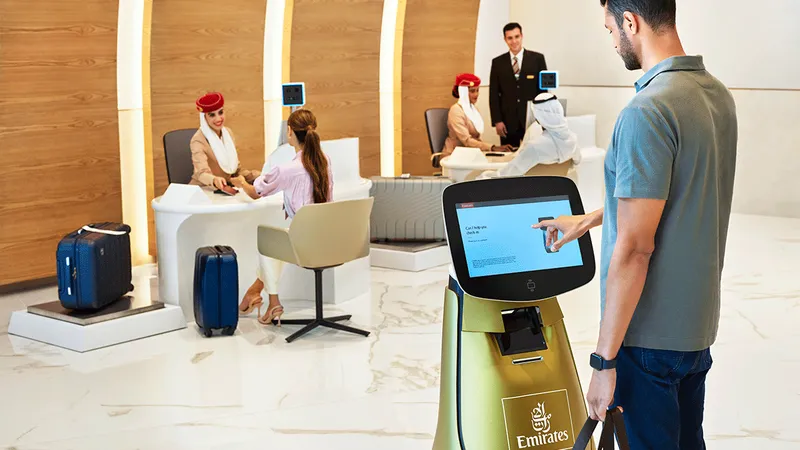
Emirates Group is developing an intelligent baggage drop robot that can use facial recognition to identify passengers, accept and weigh their luggage, and automatically attach baggage tags.
The group plans to demonstrate and officially launch the technology in the first quarter of 2027. The initiative is part of Emirates’ wider programme to automate passenger check-in and baggage handling at airports.
Kinan Hamza, Emirates Group’s Vice President of Innovation and Emerging Technologies, announced details of the project at ForsaTEK 2026 in Dubai.
The event was held at Emirates Group headquarters on September 21 and 22, 2026, showcasing applications of robotics, artificial intelligence and biometric systems in passenger services, cargo handling and aviation operations.
How will the new robot accept passengers’ luggage?
The new robot is being developed using the technology behind Emirates’ robotic check-in assistant, Sara.
Sara can currently match a passenger’s face with scanned passport details, complete the flight check-in process and direct the passenger to the baggage drop area.
The new version will extend this process to the physical acceptance of baggage.
According to Hamza, when a passenger approaches, the robot will identify and scan their face, accept and weigh the suitcase, and automatically attach the appropriate baggage tag.
This will allow several stages of passenger check-in and baggage drop to be completed through a single intelligent device.
The Sara robotic assistant is currently operating at the Emirates City Check-in and Travel Store in the Dubai International Financial Centre (DIFC).
Emirates also provides check-in services through self-service kiosks, staffed counters and off-airport baggage drop facilities at locations across Dubai.
Robotics lab to automate airport services
Emirates Group has established a dedicated robotics lab to develop automated technologies for passenger operations, cargo services and logistics processes.
Hamza said the baggage drop robot project is directly linked to the lab’s work and Emirates Group’s broader technology development programme.
At ForsaTEK 2026, the group also unveiled a drone-based system for inspecting aircraft engine components.
Hamza described the engine inspection technology as the first of its kind in the region.
Emirates Group has also automated pallet dimensioning in its cargo operations.
According to Hamza, several technologies that were under review or being tested two years ago have now entered operational use.
Through its robotics lab, Emirates Group plans to move more projects from the trial stage into practical use across airports, cargo operations and logistics services.
Using AI to personalise passenger services
In addition to developing robots, Emirates Group is using artificial intelligence to analyse passenger information and preferences.
Hamza said the group is developing systems that can review customer histories and anticipate their needs before a request is made.
Passengers’ food and beverage preferences are among the data being used in the programme.
He said the aim of using AI is to provide higher-quality services and gain a better understanding of passengers’ food and beverage preferences.
By combining AI, biometric identification and passenger data, the group plans to deliver proactive services and recommend options on future journeys based on each customer’s previous preferences.
ForsaTEK 2026 brought together representatives from the aviation, government and technology sectors. Emirates Group used the event to showcase projects that have progressed from testing towards operational deployment.
Emirates Group invests AED 17.9 billion
Emirates Group reported substantial revenue and cash assets for the financial year ending March 31, 2026.
The group’s revenue rose by 3% to $41 billion, equivalent to AED 150.5 billion.
Pre-tax profit was reported at $6.6 billion, equivalent to AED 24.4 billion, while the group’s cash assets increased to $16.2 billion, equivalent to AED 59.6 billion.
During the same period, Emirates airline alone generated revenue of $35.7 billion, equivalent to AED 130.9 billion.
The group’s total investment in aircraft, facilities, equipment and technology during the 2025-2026 financial year reached $4.9 billion, equivalent to AED 17.9 billion.
Emirates Group plans to publicly unveil and launch its intelligent baggage drop robot in the first quarter of 2027. The technology will combine passenger identification, baggage acceptance, weighing and tag attachment in a single automated process.