
Video: Tesla Unveils ‘Flying’ Roadster That Drives Upside Down and Takes to the Air
Tesla unveiled the next generation of its electric Roadster sports car on Thursday, October 15. Equipped with space technology developed by SpaceX, the vehicle drove upside down, launched into the air, rotated and landed back on the ground during a live demonstration. Elon Musk said production is scheduled to begin in 2028.
At the unveiling, held at SpaceX’s rocket testing facility in Texas, a Roadster prototype used a powerful suction system to climb a curved ramp and drive upside down. It then used cold-gas thrusters developed in collaboration with SpaceX engineers to rotate in mid-air and land.
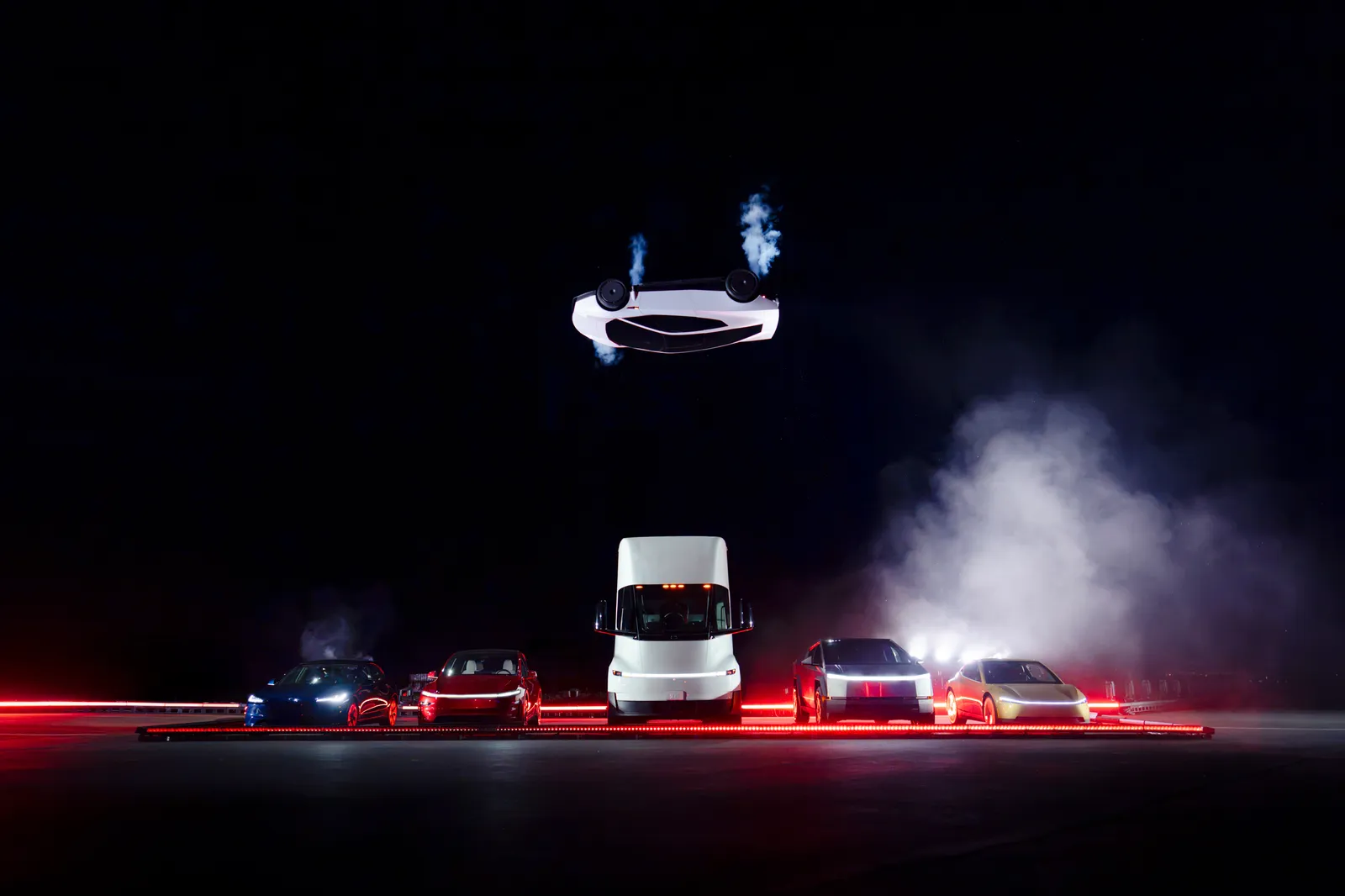
In another demonstration, the vehicle used the same thrusters to jump over several Tesla vehicles, including the Cybertruck, Cybercab, Semi truck, Model Y and Model 3. The stunts demonstrated the car’s ability to perform jumps and limited aerial manoeuvres, but do not mean it can sustain flight like an aircraft.
The next-generation Roadster was introduced in three versions: Performance, Thrust and Rocket. The Performance version features a suction system and active aerodynamics, while the Thrust version uses cold-gas thrusters to boost acceleration. The Rocket version will be fitted with additional thrusters, enabling more complex aerial manoeuvres.
Tesla claims the most powerful version, dubbed the Rocket, can accelerate from zero to 96km/h in under 0.59 seconds and reach a top speed exceeding 370km/h. However, the prototype demonstrated acceleration of about 0.8 seconds at the unveiling, and the production model’s performance has yet to be independently verified.
Unlike the other two models, the Rocket will have just one seat and is set to be offered in limited numbers on an invitation-only basis. It will feature thrusters designed to allow the vehicle to lift briefly off the ground and perform aerial manoeuvres. However, Tesla said the Rocket will not be approved for use on public roads.
Other features of the new Roadster include active aerodynamics, a steer-by-wire system with no direct mechanical connection, and styling inspired by the SR-71 and F-35 military aircraft.
Unlike conventional rocket engines, the vehicle’s cold-gas thrusters use compressed air and do not need to burn fuel to generate thrust. Tesla said high-pressure tanks installed in the vehicle will provide the energy required for these manoeuvres.
Tesla has also said the new Roadster will be able to travel more than 480 kilometres on a single charge. Final pricing for the various versions has yet to be announced, but the Performance version can be reserved with a $50,000 deposit. The payment is solely to secure a reservation and does not represent the vehicle’s sale price.
Elon Musk previously described the Roadster as “the best car from the final generation of vehicles that humans will drive themselves,” referring to a future in which he believes autonomous driving will become the dominant mode of transport.
The second-generation Roadster was first unveiled in 2017, with Tesla pledging to begin production in 2020. However, the launch was repeatedly delayed.
Musk has now set 2028 as the new target for the start of production. However, it remains unclear whether all the prototype’s showcased capabilities, particularly its aerial manoeuvres, will be available with the same performance in production models.