
New transportation plan to reduce traffic on the Dubai-Sharjah-Ajman corridor was reviewed. New transportation solutions.
New Public Transport Solutions to Connect Dubai, Sharjah, and Ajman Highlighted at UAE Infrastructure Council Meeting
New public transport solutions to connect Dubai, Sharjah, and Ajman, alongside the AED 6 billion Federal Highway project, were key topics at the first meeting of the UAE Infrastructure and Housing Council in 2026. The meeting was chaired by Suhail Mohamed Al Mazrouei, Minister of Energy and Infrastructure.
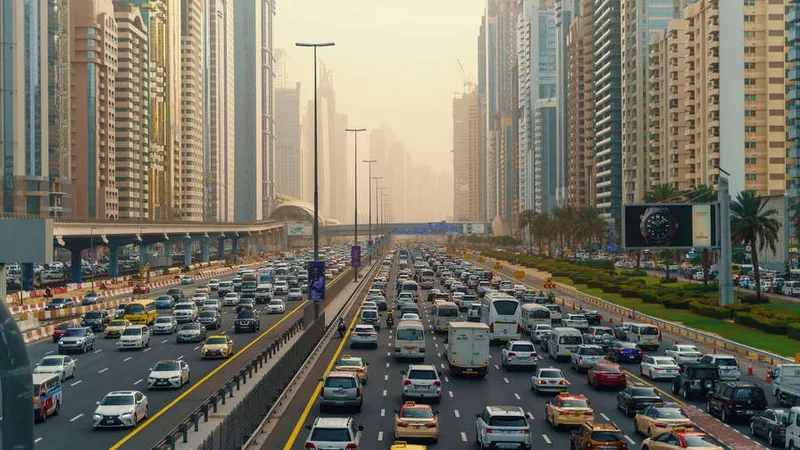
The meeting also reviewed the results of studies on curbing the growth in the number of vehicles in the UAE and solutions to reduce traffic congestion on busy routes between the Emirates.
Dubai-Sharjah-Ajman Transportation Plan
The UAE Infrastructure and Housing Council reviewed an extensive public transportation plan for one of the country's busiest commuting corridors: the Dubai, Sharjah, and Ajman axis.
The plan includes a network of 10 main routes supported by Bus Rapid Transit (BRT) systems and dedicated lanes, directly connected to metro stations and major city centers.
The BRT system is a high-capacity bus system that operates on dedicated routes, enabling faster and more reliable journeys, similar to metro services, but at a lower cost and with greater flexibility.
Officials stated that the aim of the plan is to reduce dependence on private vehicles, improve daily travel times, and strengthen connectivity between densely populated areas. Measures are also underway to more effectively connect Ajman to the third and fourth federal corridors, creating alternative routes and reducing pressure on existing roads.
Progress on the Fourth Federal Corridor Project
The meeting also reviewed the progress of the Fourth Federal Corridor project, a strategic project designed to strengthen connectivity between the Emirates and increase the overall capacity of the country's road network.
According to the plan presented, the corridor will be approximately 68 kilometers long and will include 6 to 8 lanes in each direction. It also includes the construction of 10 major intersections and four overpasses, with an estimated project cost of approximately AED 6 billion.
Officials at the meeting also discussed updating the proposed routes and coordinating with local authorities to integrate the project with broader development plans.
If implemented, this route will become the fourth national highway between the Emirates, alongside the three existing main routes: E11 (Al Ittihad), E311 (Sheikh Mohammed bin Zayed), and E611 (Emirates Road).
According to officials, this project can help streamline traffic, reduce congestion, and facilitate the movement of people and goods throughout the country.
Review of Solutions to Curb Vehicle Growth
The UAE Infrastructure and Housing Council also reviewed the results of federal policy studies on limiting the growth in the number of vehicles.
Last year, Suhail Al Mazrouei announced proposals in the Federal National Council to tighten vehicle ownership regulations to reduce traffic between Dubai and Sharjah.
He emphasized that the growth rate of the number of vehicles in Dubai has exceeded 8 percent, a figure significantly higher than the global average of about 2 percent, indicating the need to review existing policies and laws.
Proposed solutions in this area include improving road corridors between the Emirates, building new routes, better integrating public transport systems, and creating new modes of public transport.
Focus on Integrated and Sustainable Transportation
Another part of the meeting was devoted to reviewing efforts to strengthen the public transport ecosystem by connecting residential areas to major business centers.
Attendees also reviewed lessons learned from recent weather-related disruptions and emphasized the importance of enhancing preparedness, inter-agency coordination, and rapid response mechanisms to maintain road safety and traffic flow.
The UAE Minister of Energy and Infrastructure also stated that the development of public transport and the integration of different modes of transport can lead to reduced traffic, reduced pollution, and improved quality of life.