
UAE VIP Jet Heads to Tehran Again, Fueling Speculation Over Official Visit
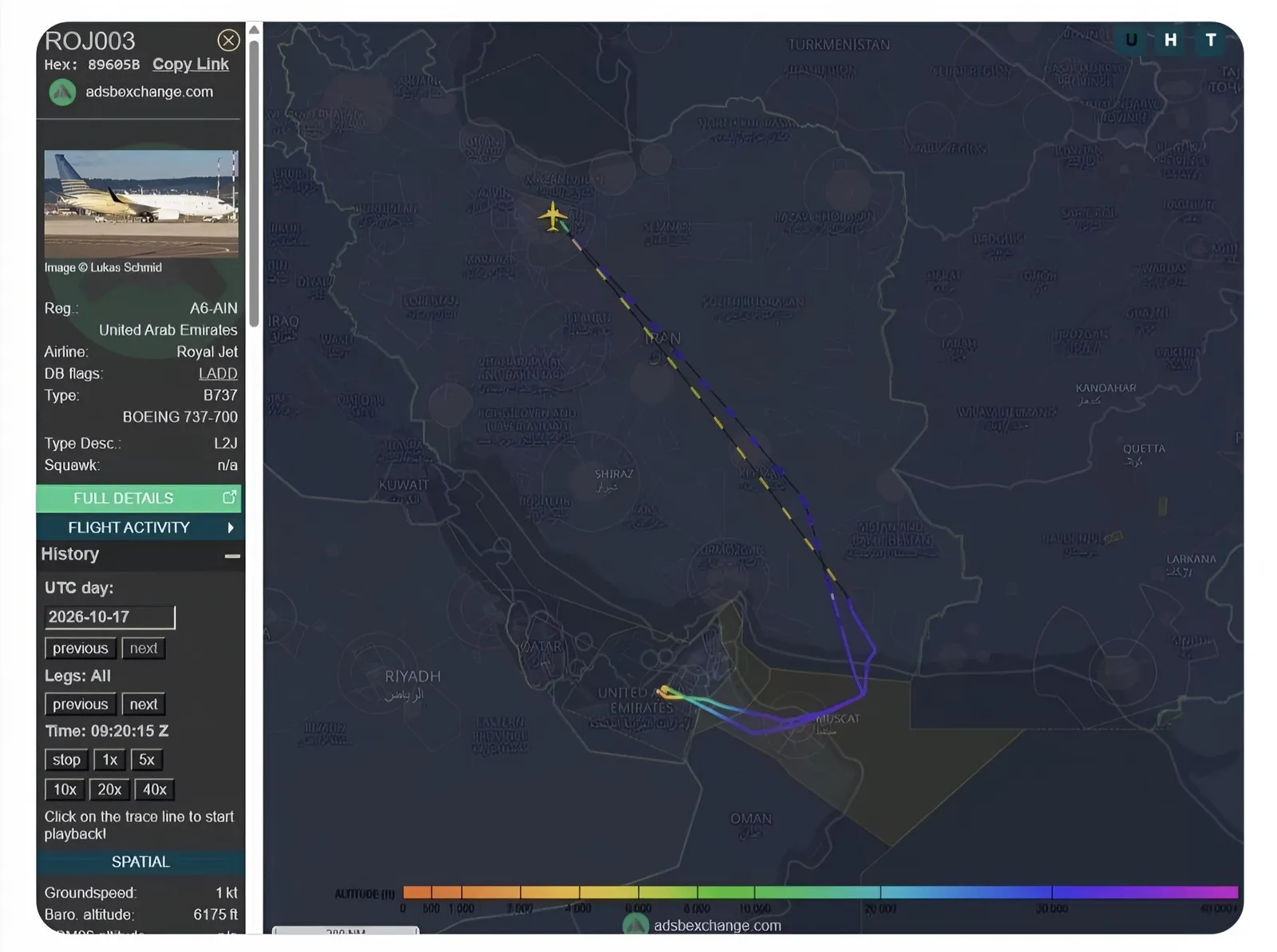
The release of radar images showing a UAE VIP jet flying to Tehran on Saturday, October 17, has fuelled speculation over a possible visit to Iran by UAE officials. This is at least the fourth reported flight to Iran by aircraft operated by the UAE’s Royal Jet since June. However, the identities of those on board and the purpose of the trip remain unknown.
Images published by the ADS-B Exchange flight-tracking platform show that a private Boeing 737, registered as A6-AIN and operating under flight code ROJ003, departed the UAE on Saturday morning before following an easterly route, entering Iranian airspace and heading towards Tehran.
The recorded route shows that the aircraft passed near Oman and over south-eastern Iran before flying towards Tehran via the vicinity of Kerman. The published image placed the aircraft in the Tehran area at around 1.20pm UAE time, although its destination airport was not identified.
Open-source intelligence monitoring account MenchOsint also published details of the flight on X on Saturday, saying that a UAE government-linked aircraft had travelled to Tehran that morning. However, the report has not been independently verified, and no information has been released about those on board.
Aircraft records show that the jet is operated by Royal Jet, an Abu Dhabi-based company that provides private and VIP aviation services to government officials, official delegations and private clients.
The aircraft is a Boeing Business Jet featuring a VIP cabin, meeting room and private rest area, with capacity for up to 46 passengers. Before joining Royal Jet’s fleet in 2005, it served in the UAE Presidential Flight fleet.
This is not the first time in recent months that flights by UAE VIP aircraft to Tehran have attracted attention. On June 8, as flights were suspended at Tehran’s two main airports, a private UAE aircraft landed at Mehrabad Airport. Iran’s Civil Aviation Organization said at the time that the flight had received official clearance and entered the country’s airspace via an eastern route.
About two months later, on August 11 and 12, another Royal Jet aircraft, registered as A6-RJA, operated two consecutive flights from Abu Dhabi to Iran. On the first flight, the aircraft travelled to Tehran and returned after a brief stop. The following day, it landed at Payam Airport in Karaj and left Iran after a stop of about 30 minutes.
The Iranians in the UAE media outlet published details of both flights at the time. Despite speculation that UAE officials may have been on board, neither country provided an official explanation about the passengers or the purpose of the trips.
The flights took place against the backdrop of strained relations between Tehran and Abu Dhabi since the US-Israeli war with Iran began on February 28, amid Iranian missile and drone attacks on the UAE and broader regional security tensions.
In a related report on June 12, Reuters cited four regional sources as saying that the UAE had agreed to release billions of dollars in funds to ease tensions with Iran. Two sources put the value of the agreement at $10 billion, while two others said it was $20 billion. Some of the sources also claimed that more than $3 billion had been made available to Iran.
Reuters said in the same report that Iranian officials had travelled to Abu Dhabi for talks with Sheikh Tahnoun bin Zayed Al Nahyan, the UAE’s National Security Adviser. UAE officials later travelled to Tehran to discuss details of the potential agreement.
However, the UAE Ministry of Foreign Affairs issued an official statement on June 13 categorically denying reports that money had been transferred to Iran, including claims involving $3 billion. It stressed that no frozen Iranian assets had been released or transferred through the UAE.
Following the August flights, some social media accounts also claimed that billions of dollars and shipments of gold had been transferred from the UAE to Iran, but no independent evidence was provided to substantiate the claims. The release of images showing the latest flight by a UAE VIP aircraft to Tehran has once again drawn attention to air travel between the two countries.
However, flight-tracking data only show the aircraft’s route and provide no information about the passengers’ identities, any possible cargo or the purpose of the trip.
At the time of publication, Iranian and UAE officials, as well as Royal Jet, had not issued an official statement on Saturday’s flight. Claims that UAE government officials were on board remain unverified.