
UAE government jet lands in Iran for second consecutive day, arriving at Payam Airport in Karaj
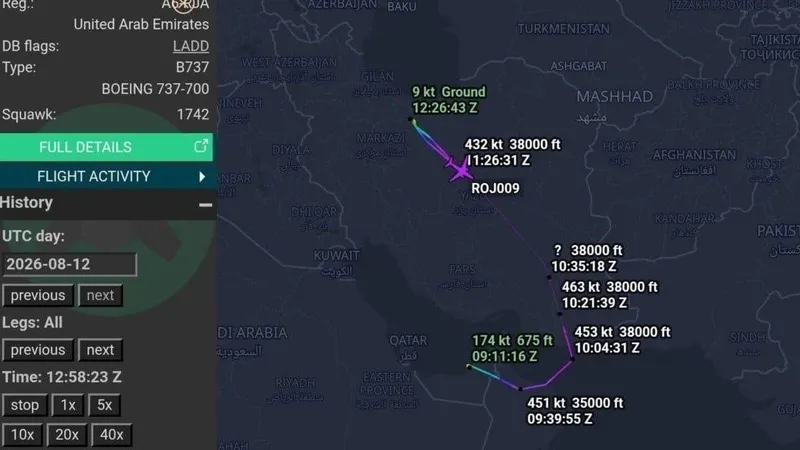
Flight tracking data reveals that a UAE government aircraft, which made headlines after a brief stop in Tehran early Tuesday, August 11, re-entered Iranian airspace on Wednesday, August 12, 2026, landing this time at Payam Airport in Karaj, approximately 40 kilometers west of Tehran. The Boeing 737-700 BBJ, registered as A6-RJA and operated by the UAE-based RoyalJet, remained at Payam Airport for about 30 minutes before departing Iranian territory, according to the data. Neither Abu Dhabi nor Tehran has offered an explanation regarding these flights or the identities of those on board.
Two consecutive flights in two days suggest a pattern that goes beyond an isolated visit. During the first flight, the aircraft traveled from Abu Dhabi to the Tehran area at dawn on Tuesday, stayed for approximately one hour, and returned. However, the specifics of the second flight have particularly drawn the attention of observers. Unlike Mehrabad, Payam is primarily a low-traffic cargo airport with no scheduled passenger flights and is owned by Iran’s Ministry of Information and Communications Technology. Analysts suggest that landing a foreign government jet at such a facility, especially while Iranian airspace remains only partially open, indicates a mutual effort to keep these diplomatic movements away from public scrutiny.
RoyalJet, which is jointly owned by Abu Dhabi Aviation and the UAE Presidential Flight, manages the core fleet used for transporting senior UAE officials. The A6-RJA aircraft has been utilized frequently for official diplomatic missions, including those involving Sheikh Shakhboot bin Nahyan Al Nahyan, Minister of State. This is the third recorded presence of the company’s jets in Iran since the outbreak of the conflict. Last June, another aircraft from the fleet flew to Mehrabad; days later, Reuters cited informed sources reporting that the UAE had transferred approximately $3 billion to Tehran as part of an arrangement to halt Iranian attacks on its soil—a report that was never officially confirmed or denied.
These unannounced flights between Abu Dhabi and Tehran are intensifying as the situation regarding the Strait of Hormuz remains in a deadlock. Tehran claims the waterway is closed, while Washington maintains it is open. Negotiations mediated by Oman regarding a safe passage mechanism have yet to reach a final agreement, and Iranian officials have linked the full reopening of the strait to new conditions. Meanwhile, oil prices have neared $90 per barrel as hopes for a quick resolution to the crisis diminish. In this environment, the continued quiet operations of the UAE government jet to Iran may point to an active direct communication channel between the two capitals—a channel that both sides currently prefer to keep confidential.