
NATO announced the coordination of 22 countries to maintain maritime security in the Strait of Hormuz.
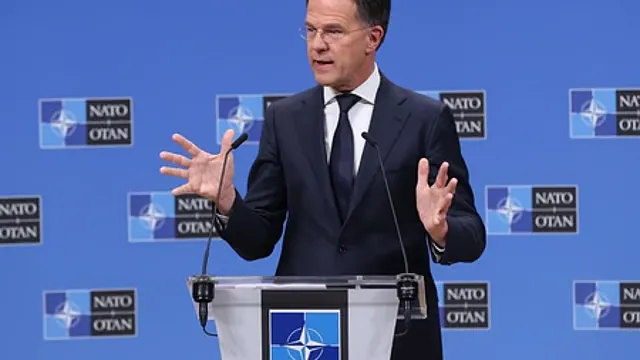
NATO Chief: Over 20 Nations Join Initiative to Secure Strait of Hormuz
NATO Secretary General Mark Rutte announced that at least 22 countries have joined an initiative aimed at ensuring maritime security and freedom of navigation in the Strait of Hormuz.
According to Rutte, these 22 nations include NATO members as well as partners of the alliance, including Japan, South Korea, Australia, and Gulf countries, who have agreed to closely coordinate efforts to maintain freedom of navigation in the narrow waterway.
These statements come amid tensions within NATO, with U.S. President Donald Trump criticizing the alliance's allies for what he called insufficient support for U.S. operations, including securing shipping lanes through the Strait of Hormuz.
Allied Coordination Begins
Rutte acknowledged the existing dissatisfaction, referring to these criticisms, but said coordination among allies is now underway.
He added that the operational timeline is still under consideration, and military planners are working on the details of troop and equipment deployments.
"One of the main questions is the issue of timing," he said.
Support for U.S. Actions Against Iran
The NATO Secretary General also supported U.S. actions against Iran, warning that Tehran is "very close to achieving" missile capabilities that could threaten Europe. This comes as NATO is also reviewing reports of a possible long-range attack on a joint U.S.-British base in the Indian Ocean.
Rutte stated, "These three questions are now being examined to respond to the President's request to ensure the free passage of ships through the Strait of Hormuz."
He explained that the planning is focused on three axes: "What do we need, when do we need it, and where do we need it?"
Speaking on CBS's "Face the Nation," he said NATO cannot yet confirm claims of a missile fired from Iran towards Diego Garcia, but emphasized that if the reports are true, the implications would be significant.
"We cannot confirm this at the moment, and we are investigating it. But if this is true, it will be further evidence that the President's action in this area is vital," Rutte said.
Warning About Direct Threat
He also added that Iran is on the verge of acquiring the ability to target major European cities.
"What we know for sure is that they are very close to achieving this capability," Rutte said.
He made these remarks in reference to the potential range of Iranian missiles.
The NATO Secretary General warned that the combination of nuclear and missile capabilities in Iran could become a global threat.
According to him, "If Iran acquires nuclear capabilities, along with missile capabilities, this will be a direct and existential threat to Israel, the region, Europe, and the stability of the world."
Rutte further supported U.S. efforts to weaken Iran's military capabilities, saying any delay in this area could be costly.
Tensions Within NATO
Comparing the situation to North Korea, he stated, "If we negotiate for too long, we may pass a point where this can still be managed."
Responding to concerns that U.S. pressure may damage NATO unity, Rutte emphasized that the alliance has maintained its cohesion many times throughout history during crises.
He pointed to the increased commitments of member states to raise defense spending during Trump's leadership, as well as continued cooperation on Ukraine.
"I understand the President's dissatisfaction that this process has taken a little time," he said, adding that allies needed time to prepare due to the confidential nature of initial U.S. actions.
NATO's Position on Ukraine
In another part of his speech, Rutte defended U.S. diplomacy regarding the war in Ukraine, although some critics have criticized the easing of restrictions on Russian oil exports.
He said Washington is balancing a range of different priorities while simultaneously working to achieve a solution through negotiation.
Rutte concluded, "He has to balance all these different interests. His effort to successfully end the war in Ukraine is crucial."