
Dubai’s Fourth Corridor Raises Hopes for Shorter Commutes, Less Traffic and Higher Property Values
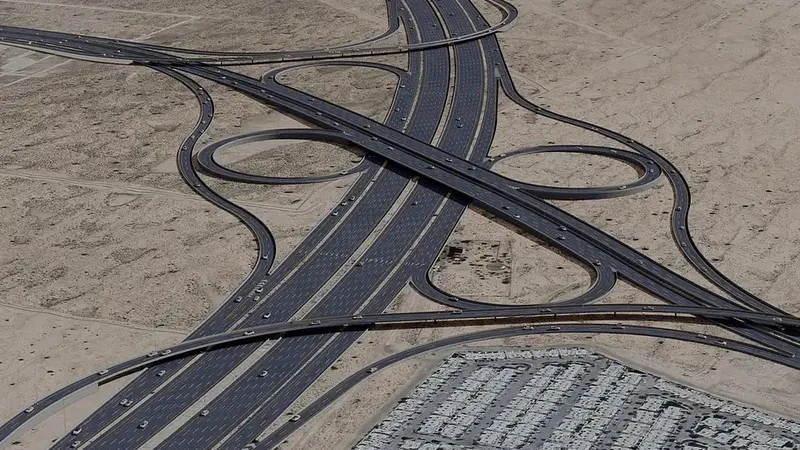
For years, residents of Dubai’s newer and more remote communities have faced lengthy journeys around the city. Travelling to school, work or even making short trips to the city centre takes up a significant portion of their day.
Some Dubai residents believe the Fourth Corridor could change this.
Damien Dexter Goveas, a 17-year-old student who has lived in DAMAC Hills 2 for nearly five years, said: “Access to other parts of the UAE and central Dubai is difficult. It takes at least 45 minutes to travel from my home to anywhere in the city.”
He believes the Fourth Corridor could improve the situation, adding: “It will make travelling into the city and to my school in Al Twar much easier and faster.”
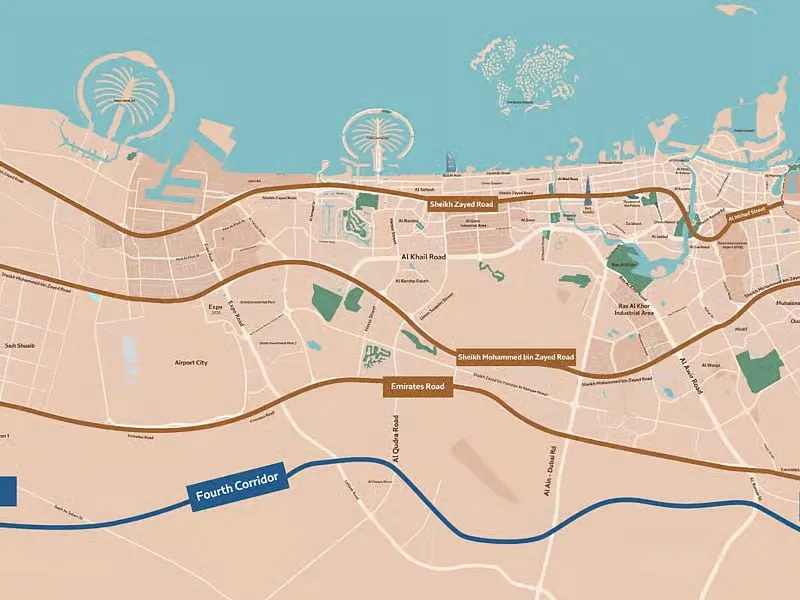
Last week, Sheikh Hamdan bin Mohammed bin Rashid Al Maktoum, Crown Prince of Dubai, approved the implementation of the 80-kilometre project in the emirate.
The Fourth Corridor is planned as the fourth major road artery connecting the emirates, alongside Sheikh Zayed Road, Sheikh Mohammed bin Zayed Road and Emirates Road.
Potential Impact on Property Prices
Mohammed, a Dubai resident who bought a property under construction in The Valley development, said he initially had reservations about the area’s distance from central Dubai.
“My initial concern was that the development was too far from central Dubai,” he said.
He said Dubai-Al Ain Road and the Dubai 2040 Urban Master Plan gave him greater confidence in his investment. With the fourth corridor now approved, he believes the decision could pay off.
The Dubai 2040 Urban Master Plan aims to develop urban areas and provide residents with sustainable and flexible transport options.
Mohammed also said an additional traffic lane is planned for the section between Emirates Road and Lahbab Road, which could help improve traffic flow.
He said the new corridor would provide faster access to Al Maktoum International Airport, Abu Dhabi, Sharjah and the Northern Emirates.
“In practical terms, we will no longer need to join one of the existing highways first when travelling to other emirates,” he added.
Asked whether he expected his property’s value to rise, Mohammed said: “Yes, definitely. This project could be a major advantage for all developments under way in this area. Connectivity and accessibility will become a selling point rather than a concern.”
Easier Commutes for Families
The project could also make travel easier for Mohammed’s family.
His daughter, who is currently studying for her A Levels, is considering universities in Academic City, Sharjah and Abu Dhabi.
“One of our concerns was travel time and accessibility,” Mohammed said. “This new project should shorten her commute, regardless of which university she chooses.”
Fourth Corridor Project Details
The project will be delivered in two phases.
The first phase will cover about 30 kilometres from Al Shnouf Road in Sharjah to Dubai-Al Ain Road and is estimated to cost about AED 3.5 billion.
The second phase will add another 50 kilometres, extending the route to Al Faya Road in Abu Dhabi.
The motorway will have 12 lanes, 72 bridges, 17 tunnels and 45 waterways and drainage channels.
The corridor will have a capacity of up to 24,000 vehicles per hour and will connect directly to Al Maktoum International Airport and the Etihad Rail network.
Planning for Dubai’s Transport Future
Joseph Salem, Partner and Head of Travel, Transportation and Hospitality at Arthur D. Little Middle East, described the project as an example of forward-looking infrastructure planning in the region.
“By integrating road, air and rail links into a single corridor, Dubai is once again demonstrating that it designs transport as an integrated system rather than a collection of separate solutions,” he said.
He said the projected 60 per cent reduction in travel time, combined with genuine links between multiple modes of transport, showed that Dubai was building capacity in line with its long-term population and economic goals rather than simply responding to today’s traffic pressures.
Calls to Expand Public Transport
For Damien, the new motorway has not only raised hopes of shorter journey times but also of expanded public transport in Dubai’s outlying areas.
“At present, there are almost no suitable public transport options for people seeking an affordable way to travel to and from the city,” he said.
“I hope that once the corridor is completed, Dubai’s Roads and Transport Authority will introduce direct, faster and more convenient bus routes into the city,” he added. “It would also be a major improvement if suitable feeder bus services were launched from the nearest Dubai Metro and Etihad Rail stations.”