
Bloomberg: UAE Oil Revenue Surpasses Last Year’s Level Despite War; Iran and Iraq See Sharp Declines
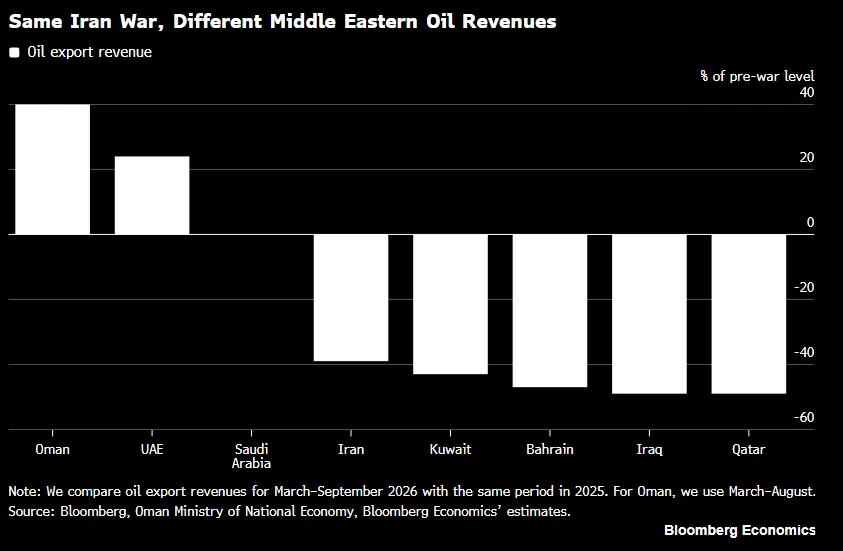
The UAE’s oil export revenue rose by more than 20 per cent between March and September 2026 compared with the same period a year earlier, amid the war in Iran and widespread disruption to regional oil trade. Bloomberg Economics estimates show that among the eight regional oil exporters included in the analysis, only the UAE and Oman increased their oil export revenues, while earnings in some neighbouring countries nearly halved.
According to a chart published by Bloomberg Economics, Oman recorded the largest increase, with oil export revenue rising by nearly 40 per cent, while Saudi Arabia’s revenue remained almost unchanged. By contrast, Iran’s oil revenue fell by about 40 per cent, Kuwait’s by more than 40 per cent, and Bahrain, Iraq and Qatar each recorded declines of nearly 50 per cent.
The sharp disparity shows that higher global oil prices alone do not guarantee increased revenue for producing countries. The ability to maintain production and exports, as well as access alternative routes that bypass the Strait of Hormuz, also plays a decisive role.
How Did the UAE Increase Its Oil Revenues?
One of the UAE’s key advantages is the Habshan–Fujairah pipeline, which transports oil from Abu Dhabi’s fields to the Port of Fujairah on the Gulf of Oman coast, with a capacity of about 1.8 million barrels per day. This route allows the UAE to deliver a significant share of its oil to global markets without passing through the Strait of Hormuz.
Another major development was the UAE’s withdrawal from the Organization of the Petroleum Exporting Countries and the OPEC+ alliance. On April 28, the UAE announced that it would leave both groups effective May 1, 2026, a decision that lifted OPEC-imposed production restrictions and gave the country greater flexibility to increase output.
According to the International Energy Agency, UAE crude oil production reached a new record in September, exceeding 4.4 million barrels per day. The country’s total oil and gas condensate production also rose by about 400,000 barrels per day from the previous month to 5.3 million barrels per day.
However, the UAE’s export performance has varied over the course of the war. Data published by specialist energy platform Attaqa showed that the country’s seaborne crude oil exports fell to 2.1 million barrels per day in March, before rising to 3.8 million barrels per day in June and reaching 3.36 million barrels per day in September.
According to the same data, the UAE’s average seaborne crude oil exports in the first nine months of 2026 were about 4.2 per cent lower than in the same period a year earlier. The increase in the UAE’s oil export revenues therefore did not necessarily reflect higher export volumes throughout the period, with elevated oil prices also playing a significant role in the growth.
Oman Emerges as Biggest Oil Winner From War
Oman, whose main oil export terminals are located outside the Strait of Hormuz, has largely avoided the widespread disruption to regional energy export routes.
According to Oman’s National Centre for Statistics and Information, the country exported about 209 million barrels of oil from January through the end of August 2026, up 1.9 per cent from the same period last year. The average price of Omani oil also rose 15.5 per cent during the period to $83.3 per barrel.
Saudi Arabia has also offset some of the war-related export constraints by using its East-West pipeline to transport part of its oil to the Red Sea port of Yanbu. Bloomberg estimates that higher oil prices have almost fully compensated for the decline in export volumes, leaving the country’s export revenues close to last year’s level.
Sharp Revenue Declines Hit Iran, Iraq and Other Regional Countries
By contrast, countries more dependent on the Strait of Hormuz route have suffered greater damage. Iraq, Kuwait, Qatar and Bahrain have experienced steep declines in export revenues, with repercussions extending beyond the oil industry.
In Iraq, declining oil revenues have placed considerable pressure on foreign currency reserves and the state budget. In early October, the government approved an approximately 14.5 per cent reduction in the dinar’s official value against the US dollar. Economists said the decision was linked to problems caused by lower oil sales and the government’s need to secure funding.
Iran has also seen a dramatic shift in its oil export position during the war. The country maintained some crude oil exports in the initial months, but the US naval blockade and subsequent restrictions sharply reduced shipments. According to tanker-tracking data published by Reuters, Iran’s crude oil exports fell to zero in September, although limited exports of some petroleum products, including liquefied petroleum gas and jet fuel, have continued.
Higher Oil Revenue Does Not Mean UAE Economic Growth
Despite the UAE’s stronger oil export performance, the war continues to inflict heavy losses on other sectors of the country’s economy.
In its October 2026 World Economic Outlook, the International Monetary Fund forecast that the UAE economy would contract by 3.9 per cent this year. It also projected a 3.3 per cent contraction in Saudi Arabia, a 7.6 per cent decline in Iran and a 15.6 per cent contraction in Qatar.
By contrast, Oman, with projected economic growth of 4.1 per cent, is the only Gulf Cooperation Council country expected to record positive growth in 2026.
These forecasts indicate that even higher oil export revenues cannot fully offset the losses caused by disruptions to trade, transport, tourism and investment.
A key point when examining Bloomberg’s chart is that, for most countries, the comparison is based on oil export revenues from March to September 2026 against the same period in 2025. For Oman, the period from March to August was used. The figures therefore reflect changes in the value of oil exports and should not be interpreted as changes in export volumes, the oil industry’s net profit or governments’ total revenue.
Overall, Bloomberg’s data show that the Iran war has not affected the Middle East’s oil-producing countries equally. While some countries have experienced sharp declines in oil revenues, the UAE and Oman have maintained key export routes and benefited from higher oil prices, enabling them to earn more from oil exports than last year.